
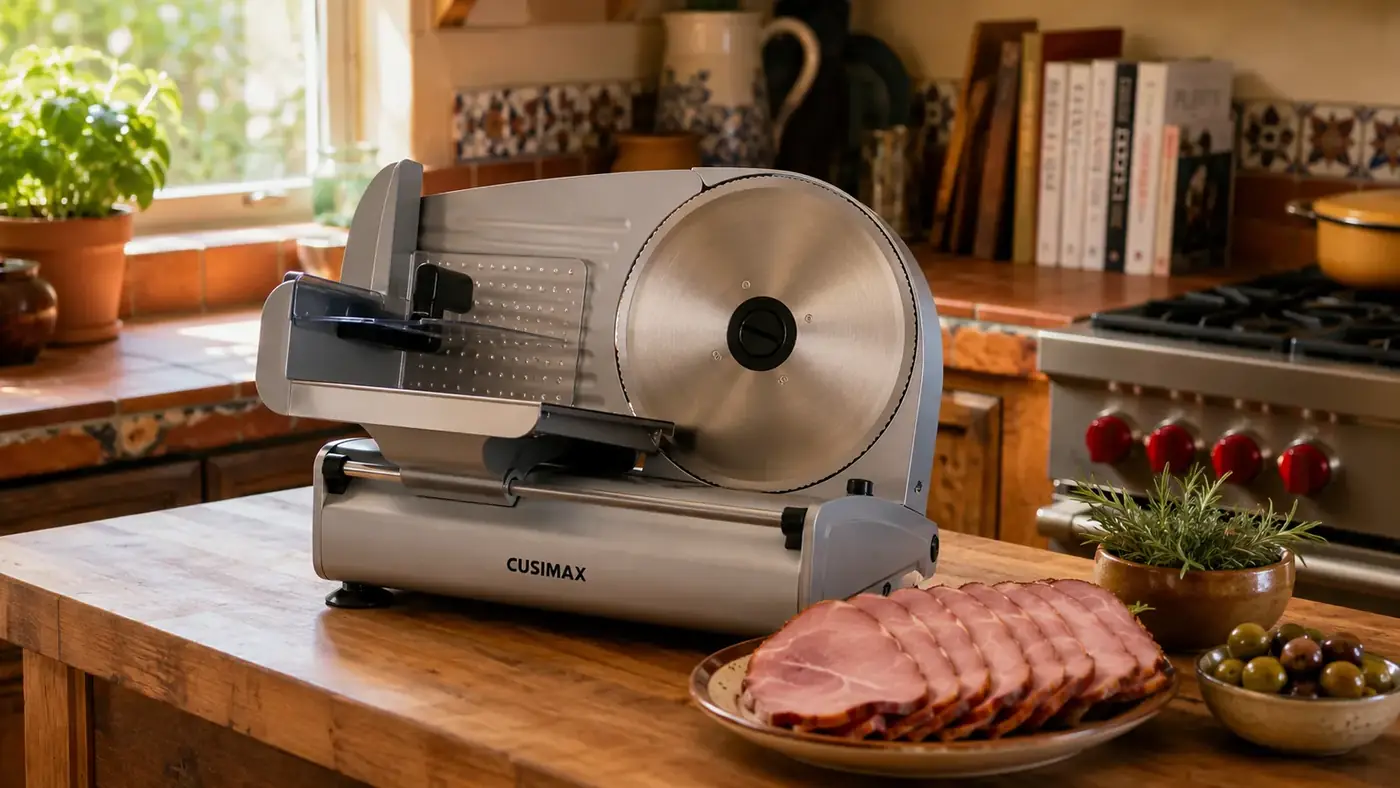
For thirty years I ran the kitchen at a Tucson elementary school, feeding about 600 kids a day, and if there was one thing I trusted with my life in that prep room, it was the industrial slicer against the back wall. When I retired in 2023, I figured slicing meat for a living was behind me for good. Then my husband Manny started buying sliced ham and turkey from the deli counter every single week, and I watched our grocery total creep up past what felt reasonable for lunch meat two people could slice themselves. That's when I bought the CUSIMAX electric meat slicer, the model with the two removable 8.7 inch stainless blades, back in January. Six months and roughly ninety pounds of ham, turkey breast, brisket, and semi-frozen pork loin later, I have a real answer on whether this thing earns its spot on the counter.
I want to be upfront that I'm not grading the CUSIMAX against the fourteen-inch commercial units I ran for three decades. Those cost more than my first car and needed a dedicated outlet. This is a home slicer at a home price, and I'm judging it on that scale, not against a restaurant supply catalog.
The Quick Verdict
The CUSIMAX handles weekly deli-style slicing better than I expected for its price, with real thickness control and blades that hold an edge, but the motor asks for patience on anything thick, cold, or bone-in.
Amazon Check Today's Price →Tired of paying deli prices for pre-sliced ham you could cut thinner yourself?
The CUSIMAX slicer is what turned our weekly deli run into a fifteen-minute job at home, with control over thickness the deli counter never gave us.
Amazon Check Today's Price on Amazon →How I've Used It
My routine settled in fast. Sunday afternoon, after we get back from the grocery store, I set the CUSIMAX on the counter next to the sink, pull out a two to three pound block of ham or turkey breast, and slice enough for Manny's lunches and my own sandwiches through Thursday. That's usually fifteen to twenty minutes including cleanup, for what would take forty-five minutes standing at a deli counter waiting for a number to be called, plus the drive there and back.
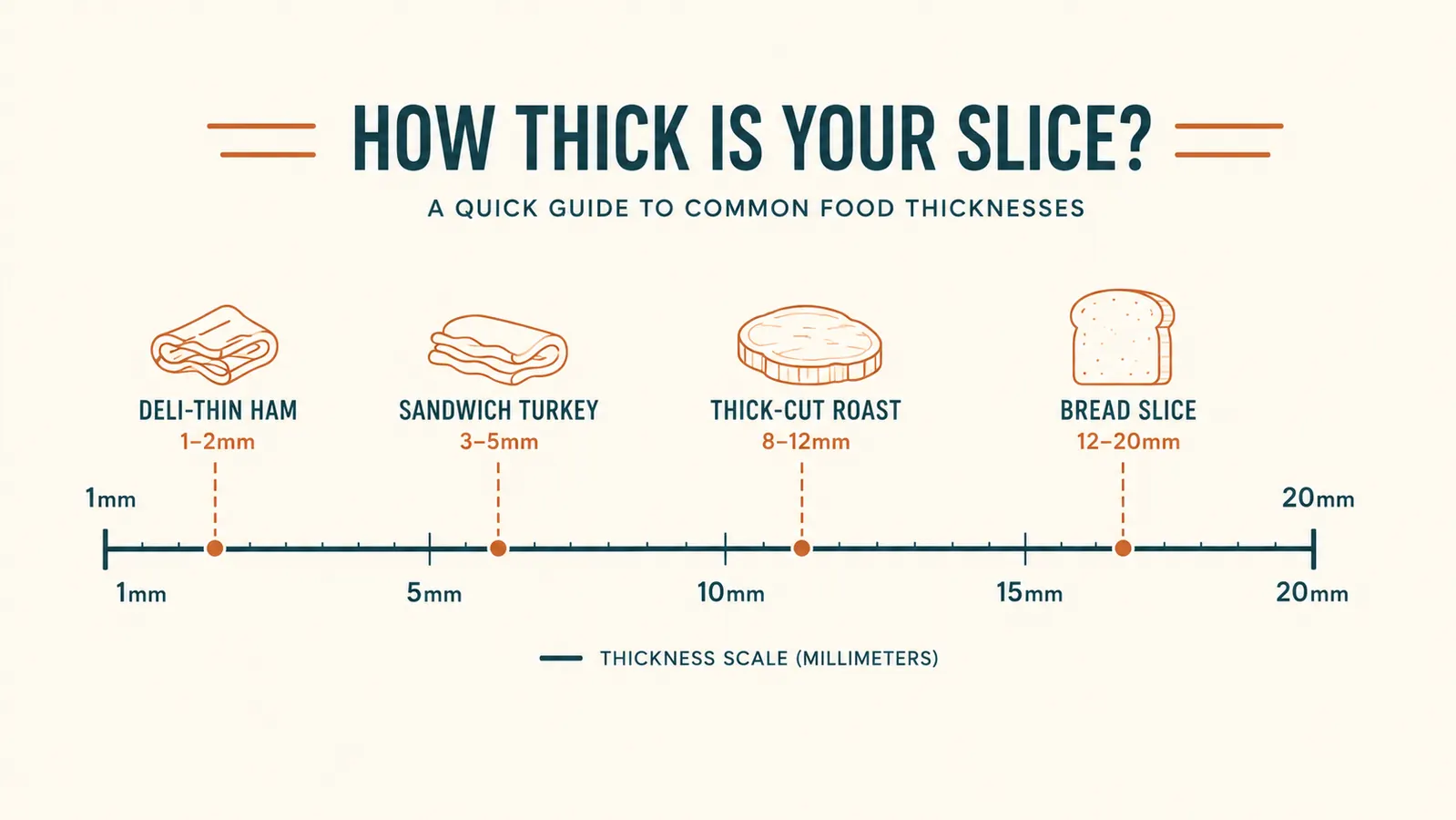
The thickness dial runs from about 1mm up to 20mm, and I use nearly the whole range depending on what's going through it. Paper-thin for prosciutto and salami, a medium setting around 4-5mm for sandwich turkey and ham, and the thick end for roast beef I want to fork through rather than bite through. I've also run it through a semi-frozen pork loin for stir-fry strips, sharp cheddar for a party tray, and a crusty baguette when I wanted uniform slices for a dinner I was hosting for my sister's birthday in March.
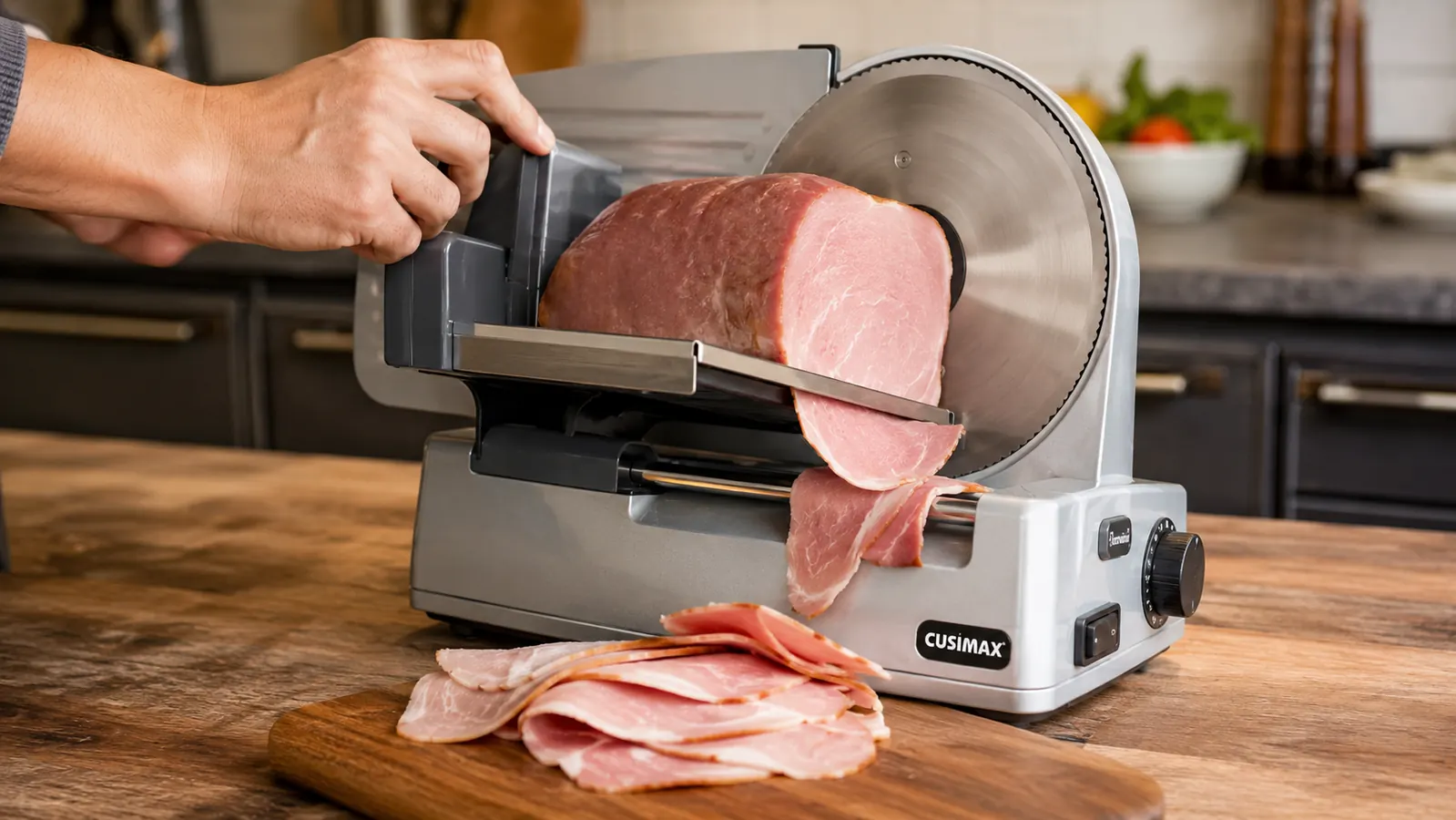
The food carriage is where the CUSIMAX either earns its keep or doesn't, and for me it mostly does. It holds the meat block steady against the blade with a spring-loaded pusher, so my hand never gets closer than about four inches to the edge. After thirty years of cafeteria kitchens where a slicer injury meant a workers' comp form and a very bad afternoon, that distance matters to me more than almost any other spec on the box.
I've also learned a few small habits that make the CUSIMAX run better week to week. I chill the meat block in the freezer for about ten minutes before slicing, just enough to firm it up without freezing it solid, since a slightly firmer block holds its shape against the blade far better than room-temperature meat that wants to squish under the pusher. I keep a folded towel under the base too, since our countertop has a slight lip near the sink and the extra grip stops any creeping during a long slicing session.
The Blade and Motor: What a Cafeteria Kitchen Taught Me to Look For
The CUSIMAX ships with two removable 8.7 inch stainless blades, which sounds like a small detail until you've run a slicer daily and watched a single blade dull halfway through a shift. Having a spare means I can swap in a fresh edge while the other soaks in soapy water, and after six months of weekly use, both blades still bite into a cold ham block cleanly rather than tearing it. That's a longer edge life than I expected at this price point.
The motor is where I'll be the most honest. This is not an industrial motor, and it doesn't pretend to be one. On a room-temperature ham or turkey breast, it moves through consistent, even slices without straining. On a nearly frozen pork loin, though, I can hear it working harder, and I've learned to let meat sit out for ten to fifteen minutes before slicing rather than pulling it straight from the freezer. Brisket with a thick fat cap also asks more of the motor than a lean ham does, and I slow my push speed down on those cuts so the blade isn't fighting the fat.
I ran an informal comparison the second month I owned it, slicing the same two pound ham block on the thinnest setting and timing myself, then repeating it after four months of regular use. The time barely changed, about ninety seconds either way, which told me the CUSIMAX blade wasn't losing its edge the way a cheaper single-blade slicer might over the same stretch.
Slicing Performance Over Six Months, Not Just Week One
A lot of reviews get written after one weekend with a new gadget, and I understand why, but that's not how you find out whether something holds up. By month three, the CUSIMAX had become such a normal part of our Sunday routine that Manny started asking for it by name, as in "did you CUSIMAX the ham yet," which tells you it stuck.
Where it's been most consistent is with dense, uniform proteins: deli ham, turkey breast, hard salami, and semi-hard cheeses like cheddar and gouda. Those come out even every time, slice after slice, without the sawing motion you get from a knife. Where it's less consistent is with anything irregular in shape, like a bone-in cut or a roast with an uneven fat seam. I've had a few slices tear rather than cut clean on those, and I've learned to trim the odd shapes off before loading the carriage.
Noise level is moderate, comparable to a stand mixer on a medium speed, and I can run it at 7am without waking anyone up in our house. Vibration is minimal thanks to the rubber feet on the base, and after six months those feet still grip the counter without sliding, even on our laminate countertop which isn't perfectly flat.
The Real Cost Math After Six Months
I kept a rough running tally in a kitchen notebook, the same habit I had from tracking cafeteria food costs for thirty years, and it's paid off in a way I didn't expect this fast. Deli ham and turkey at our local grocery ran us close to nine dollars a pound sliced to order. Buying whole ham and turkey breast blocks and slicing them ourselves with the CUSIMAX brings that down closer to five dollars a pound, and that gap alone covered the cost of the slicer within about four months of normal weekly buying.
There's a time cost too that doesn't show up on a receipt. We used to make a separate stop at the deli counter on grocery day and wait for a number, sometimes ten or fifteen minutes on a busy Saturday. Now I slice everything for the week in one Sunday session while dinner is in the oven, and that stop is simply gone from our routine.
Cleanup and Maintenance, the Part Nobody Talks About
Here's what thirty years in institutional kitchens taught me: the equipment people love in the showroom is not always the equipment people actually clean after every use, and if it's a pain to clean, it stops getting used. The CUSIMAX blades and food carriage are removable and dishwasher safe on the top rack, which matters more to me than almost any other feature, because I know myself, and if cleanup took twenty minutes I'd start reaching for the deli counter again by week three.
In practice, I hand wash the blade separately from the rest, because I don't love the idea of a razor-sharp blade knocking around in a dishwasher rack next to forks. That takes about ninety seconds with a sponge and warm water, careful and deliberate, blade moving away from my hand the whole time. The rest of the housing wipes down with a damp cloth in under a minute.
One maintenance note worth flagging: the blade release mechanism needs a firm, deliberate press to disengage, not a light touch. The first month I fumbled it a few times trying to be gentle, and gentle doesn't work here. Once I learned to press with real intention, it came apart cleanly every time.

Who Needs This Versus a Good Knife
Before buying the CUSIMAX, I seriously considered just getting a better knife and a honing steel, since that's what I used at home for years before this. A sharp knife works fine for the occasional roast, but it can't give you the same thickness twice in a row, and it takes real time and skill to get restaurant-thin slices without a machine doing the work. For a household slicing deli meat weekly, the machine wins on consistency and time saved, hands down.
I also looked at a couple of higher-end slicers with all-metal gears before settling on this one, mostly because Manny didn't want to spend three or four times as much on something that would sit unused most days. Six months in, I think that was the right call for our household size and use case, though I get into where a pricier model might make more sense in the comparison piece I wrote against BESWOOD.
What I Liked
- Two removable stainless blades hold their edge through months of weekly use
- Thickness dial genuinely runs paper-thin to thick-cut, not just in the marketing copy
- Food carriage keeps hands a safe distance from the blade
- Blades and carriage are dishwasher safe on the top rack
- Quiet enough to run early morning without waking the house
- Paid for itself in grocery savings within about four months for our household
Where It Falls Short
- Motor works noticeably harder on semi-frozen or thick fat-capped cuts
- Struggles with irregular or bone-in shapes, works best on uniform blocks
- Blade release mechanism needs a firm press, not intuitive at first
- Not built for daily commercial-style volume, this is a household tool
After thirty years running a cafeteria slicer where one careless second could cost someone a finger, the distance between my hand and the CUSIMAX blade is the spec I actually care about most, not the horsepower number on the box.
Who This Is For
If your household goes through deli meat and cheese on any kind of regular basis, weekly sandwiches, meal-prepped lunches, a standing Sunday charcuterie habit, the CUSIMAX pays for itself in grocery savings within a few months and gives you control over thickness the deli counter never will. It's also a good fit if you cook in batches, since slicing a semi-frozen roast into stir-fry strips or a block of cheese for a party tray takes a fraction of the time a knife would. Anyone tracking a grocery budget the way I tracked cafeteria food costs for thirty years will appreciate having that math actually work in their favor.
Who Should Skip It
If you only slice meat a few times a year, or if most of what you cut is bone-in or oddly shaped, like a whole chicken or a rack of ribs, this isn't the tool for that job and a good knife will serve you better. Anyone expecting commercial, all-day volume out of a home-price motor is going to be disappointed too. This is built for a household kitchen doing a few pounds a week, not a deli counter's daily throughput, and buyers hoping for that kind of workload should look at a heavier, pricier machine instead.
Ready to stop overpaying at the deli counter for slices you could cut thinner at home?
Six months of weekly ham, turkey, and cheese later, the CUSIMAX is still the first thing I reach for on Sunday grocery day.
Amazon Check Today's Price on Amazon →