
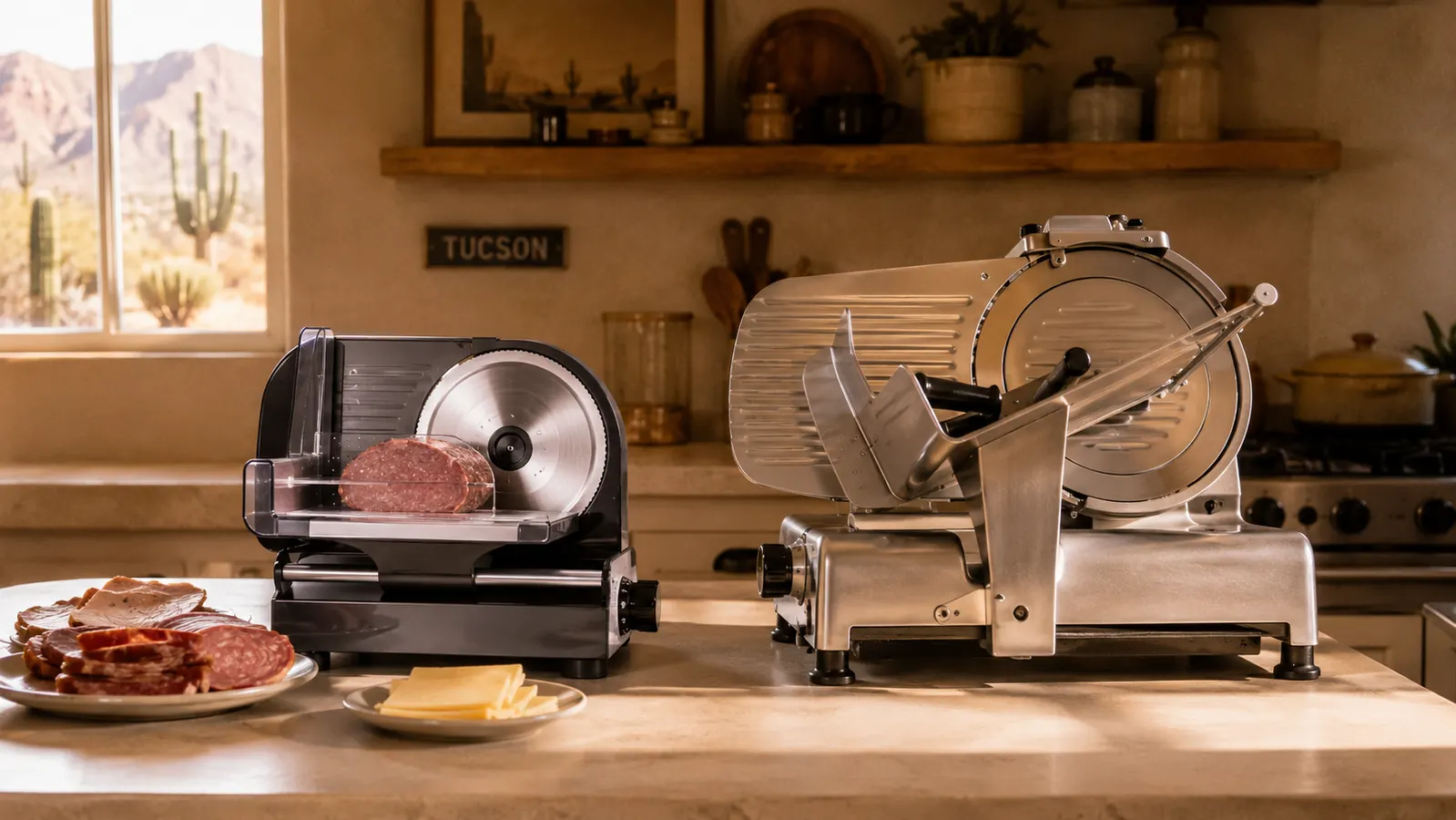
If you just want the short answer, my CUSIMAX Electric Deli Meat Slicer is the one still sitting on my counter every Sunday, and after spending a full weekend running it side by side against a neighbor's BESWOOD 250 on the same brisket and the same block of cheddar, I'd buy the CUSIMAX again for a normal home kitchen. But thirty years running a school cafeteria kitchen for 600 kids a day taught me that the right piece of equipment always depends on how much meat you're actually moving through it, and the BESWOOD isn't a bad machine, it's just built for a different job than mine.
My neighbor Frank has run a BESWOOD 250 in his garage for two years, mostly for deer processing and the occasional whole ham around the holidays, so I borrowed it for a weekend and set it up right next to my CUSIMAX on my own counter. Same brisket, same block of Colby, same rye bread for the deli-style test. Both machines solve the same basic problem, uneven hand-cut slices and a wrist that gives out after ten minutes with a knife, but the CUSIMAX and the BESWOOD 250 go about it in noticeably different ways once you get past the spec sheet, and that gap only got clearer the longer we ran them side by side.
| CUSIMAX Electric Deli Meat Slicer | BESWOOD 250 Meat Slicer | |
|---|---|---|
| Blade Size | 8.7-inch stainless steel blade, comes with a spare, easy to hand-wash | 10-inch chrome-plated carbon steel blade, sharper out of the box but rusts if you air-dry it |
| Thickness Range | 1 to 20mm adjustable dial, covers everything from shaved deli meat to a thick pork chop | 0 to 15mm adjustable dial, tuned more for consistent deli-thin cuts than thick slabs |
| Motor Power | 150-watt motor, plenty for boneless meat, cheese, and bread in a home kitchen | 240-watt motor, noticeably more torque for partially frozen roasts and dense whole cuts |
| Food Carriage | Fully removable carriage, lifts out in one motion for cleanup at the sink | Fixed carriage on Frank's unit, wipes clean in place but never leaves the machine |
| Footprint | About 15 inches wide, tucks into a cabinet or a corner of the counter between uses | About 19 inches wide with a taller blade guard, Frank keeps his on a dedicated garage shelf |
| Weight | Around 12 pounds, one hand to lift and carry to the sink | Around 24 pounds, a two-hand carry every single time |
| Price | Today's price sits well under a commercial-grade unit, built for a home kitchen budget | Runs noticeably higher, priced closer to a small-shop deli tool than a home appliance |
| Best Suited For | A household slicing deli meat, cheese, and bread once or twice a week | Hunters processing whole animals or anyone slicing dense, partially frozen cuts often |
First Cuts, Side by Side
Setup on my CUSIMAX took about ten minutes, most of it spent finding a spot on the counter with enough clearance for the food carriage to slide all the way out. Frank's BESWOOD 250 took closer to twenty minutes just because of the weight, he needed both hands to get it positioned and level on his garage shelf before he'd even plugged it in. If you're short on counter space or you live alone and don't want to wrestle a 24-pound machine into place every time, that's a real point for the CUSIMAX right from the first plug-in.
The first test cut told me most of what I needed to know. On the same brisket, at the same 6mm setting, my CUSIMAX produced slices that were consistent edge to edge, maybe a hair thicker on the very last pass as the meat got small. Frank's BESWOOD 250 sliced with more raw power, the 240-watt motor barely slowed down even on a partially frozen section we tested on purpose, but the extra size and weight of the machine meant Frank had to stand further back and use both hands to guide the meat safely. For a quick Sunday deli sandwich, the CUSIMAX felt like the friendlier machine to actually use, and my grandson could probably load its carriage safely, which is more than I'd say about Frank's setup.
Where CUSIMAX Wins
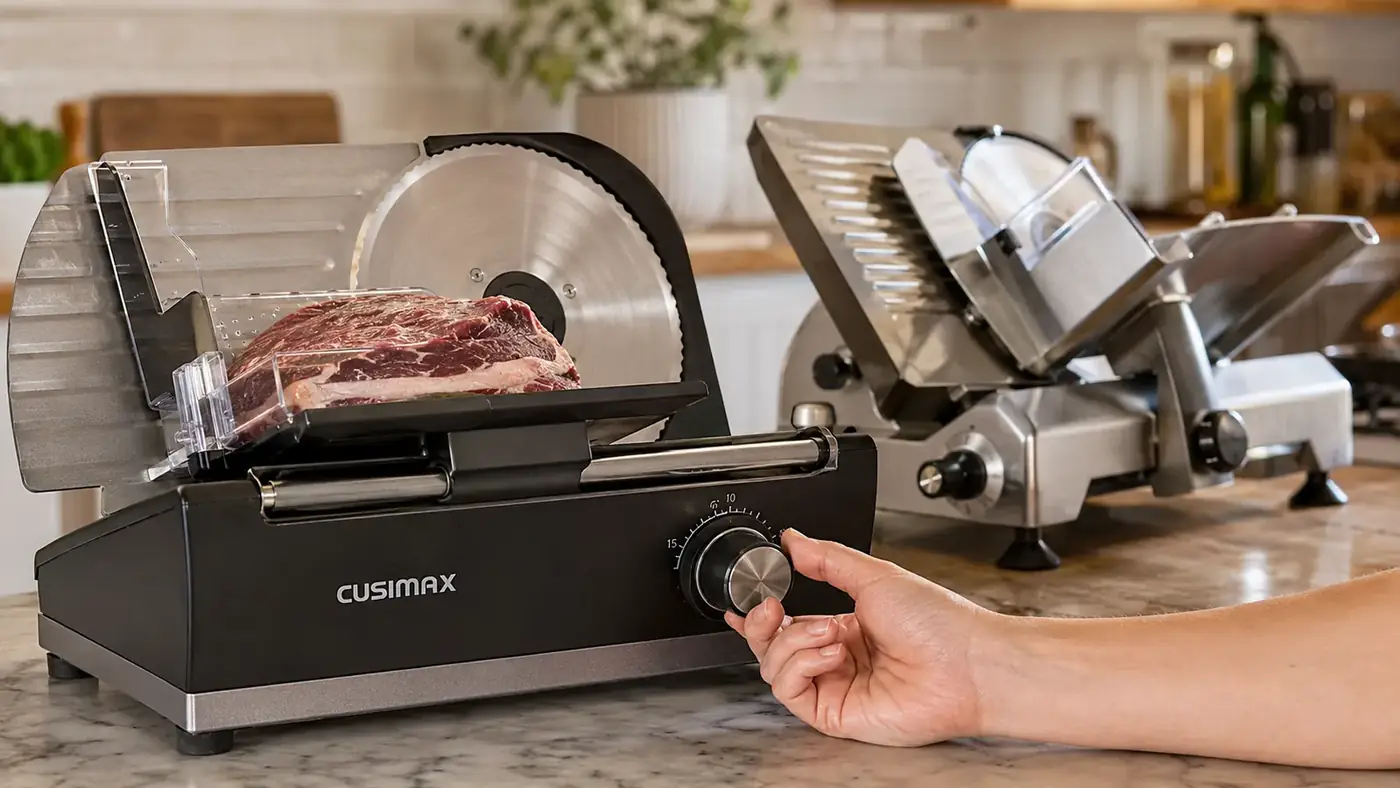
The removable food carriage is the biggest gap between the two. CUSIMAX built this slicer so the entire carriage lifts out in one motion, straight into the sink or dishwasher-safe rack, no scrubbing around a fixed tray while it's still bolted to the machine. Frank's BESWOOD 250 has a fixed carriage, so he wipes it down in place every time, and he told me flat out that he dreads cleanup more with his machine than I ever do with mine. After thirty years of health-code cleaning standards in a cafeteria kitchen, that difference alone would decide it for me.
The thickness range is the other clear win for everyday use. CUSIMAX's dial runs from 1mm all the way to 20mm, which covers shaved deli ham at one end and a proper thick pork chop at the other, all on the same machine. The BESWOOD 250 tops out around 15mm, tuned more for consistent deli-style cuts than the thicker slabs I sometimes want for a Sunday roast. CUSIMAX also comes with two removable blades in the box, so when one needs sharpening, I swap the spare in and keep slicing instead of waiting on a repair, something Frank has genuinely envied since I mentioned it to him.
Where BESWOOD Wins
It isn't a total wash, though. The BESWOOD 250's 240-watt motor has real advantages if you're processing anything dense or partially frozen. Frank runs venison through his most falls, and the extra torque plows through cuts that would bog down a lighter home machine. His 10-inch blade is also a genuine half-inch larger in diameter than CUSIMAX's 8.7-inch blade, which matters if you're slicing whole roasts or big hams where a bigger blade means fewer passes to get through the cut.
The BESWOOD 250 is also built heavier in a way that shows up as stability. At 24 pounds versus the CUSIMAX's 12, Frank's machine simply doesn't shift on the counter the way a lighter slicer can under aggressive use. If you're running a slicer daily for a home business, a hunting camp, or a family that processes its own meat, that added weight and motor power starts to earn its keep in ways a once-a-week household never needs.
Trying to Decide Between a Home Slicer and a Garage-Shop Slicer?
After a weekend testing both machines on the same brisket, the CUSIMAX still came out ahead for anyone slicing deli meat, cheese, and bread once or twice a week in a normal kitchen. See today's price and current availability before you decide.
Amazon Check Today's Price on Amazon →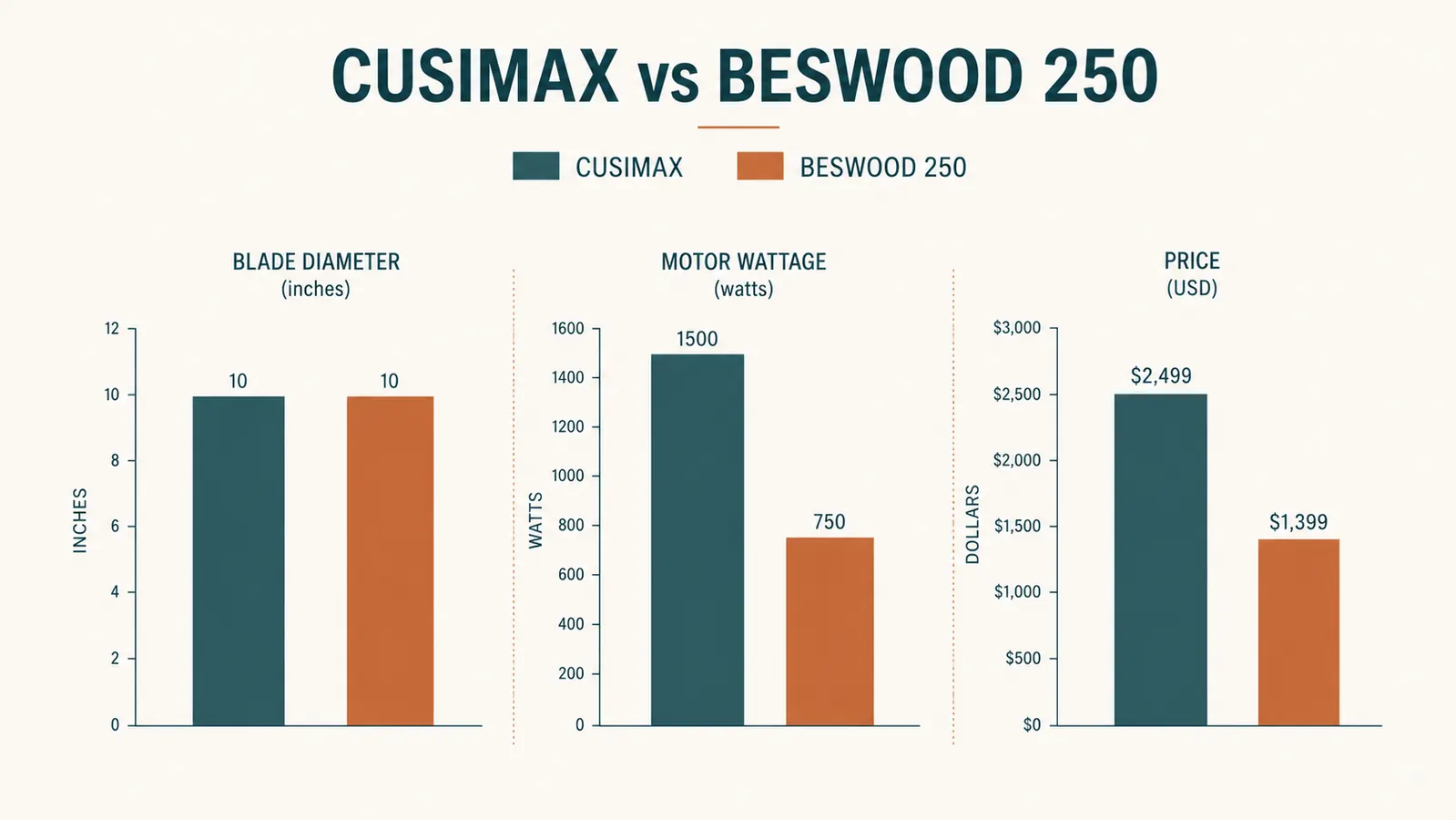
Blade Care and Cleanup
Blade care is where the two machines really part ways in daily life. CUSIMAX's stainless steel blades hand-wash and air-dry without a second thought, I've never seen a spot of rust on either of my two blades in six months. Frank's BESWOOD 250 uses a chrome-plated carbon steel blade, and he learned the hard way that air-drying it after a wash left faint rust spots within a month. Now he towel-dries his BESWOOD blade every single time and keeps a light coat of food-safe mineral oil on hand, an extra step CUSIMAX owners simply don't have to think about.
Sharpening schedules are close between the two if you're slicing similar volumes, roughly every two to three months for regular home use. But because CUSIMAX ships with a spare blade, I swap mine and send the dull one out for sharpening without ever losing a Sunday. Frank has to either sharpen his single BESWOOD blade himself with a stone or go a week or two without his slicer while a shop handles it, since BESWOOD doesn't include a backup blade in the box.
Footprint and Everyday Convenience
Counter space matters just as much as slicing power in a normal-size kitchen. My CUSIMAX sits at about 15 inches wide and I store it in a lower cabinet between the toaster and the mixer, pulling it out only on Sundays. Frank's BESWOOD 250 needs a dedicated shelf in his garage because of its taller blade guard and wider footprint, it's simply not a machine he'd want tucked into a kitchen cabinet even if he had the room.
Weight makes the everyday difference too. At 12 pounds, I lift my CUSIMAX out with one hand and set it up solo in under a minute. Frank's BESWOOD 250 is a two-hand carry every time, which he doesn't mind in a garage setup where it stays put most of the year, but it would be a genuine chore in a small apartment kitchen where the slicer needs to come out and go away with every use.

Long-Term Reliability
Frank's BESWOOD 250 is coming up on two years old, and his one issue was a loose blade guard screw in year one that he tightened himself with a screwdriver from the included toolkit. My CUSIMAX, at six months and roughly 130 slicing sessions, has had one small hiccup of its own, a thickness dial that stuck slightly after I let raw meat juice dry on it overnight. A warm damp cloth and a little patience fixed it, and it hasn't stuck since. Neither machine has needed an actual repair, but neither one is completely maintenance-free either.
Where the two really diverge is how often each machine actually gets used. Frank's BESWOOD 250 runs hard for a few intense weeks around hunting season and then sits mostly idle the rest of the year, which is exactly the use case it was built for. My CUSIMAX runs every single Sunday without fail, and that steadier, lighter-duty pattern is exactly what its smaller motor and body were designed around. Judging either machine against the other's use case would be unfair to both brands, and I try to keep that in mind whenever someone asks me which one is simply better.
Two slicers, two very different jobs. Frank's BESWOOD 250 handles a whole deer in November. My CUSIMAX handles Sunday's brisket and Tuesday's sandwich cheese, and that's the machine most kitchens actually need.
Who Should Buy Which
Buy the CUSIMAX if you're slicing deli meat, cheese, and bread for a household once or twice a week, you want a removable carriage that actually makes cleanup easy, and you'd rather keep the machine in a cabinet than dedicate a shelf to it. It's the more practical choice for the vast majority of home kitchens, and the spare blade alone saved me more downtime than I expected going in.
Buy the BESWOOD 250 if you're processing whole game, big hams, or partially frozen dense cuts regularly, and you have a garage or dedicated space where a heavier, higher-powered machine can live permanently. It's a genuinely capable slicer, Frank's had two solid years with his, but I'd only choose it over the CUSIMAX if your slicing needs look more like a small shop than a family kitchen most days of the year.
Ready to Stop Hand-Slicing Deli Meat With a Wrist That's Had Enough?
Between the two, the CUSIMAX handled everyday home slicing with easier cleanup, more thickness range, and a lighter footprint than the shop-grade BESWOOD ever needed to. Check its current price and availability before it changes.
Amazon Check Today's Price on Amazon →