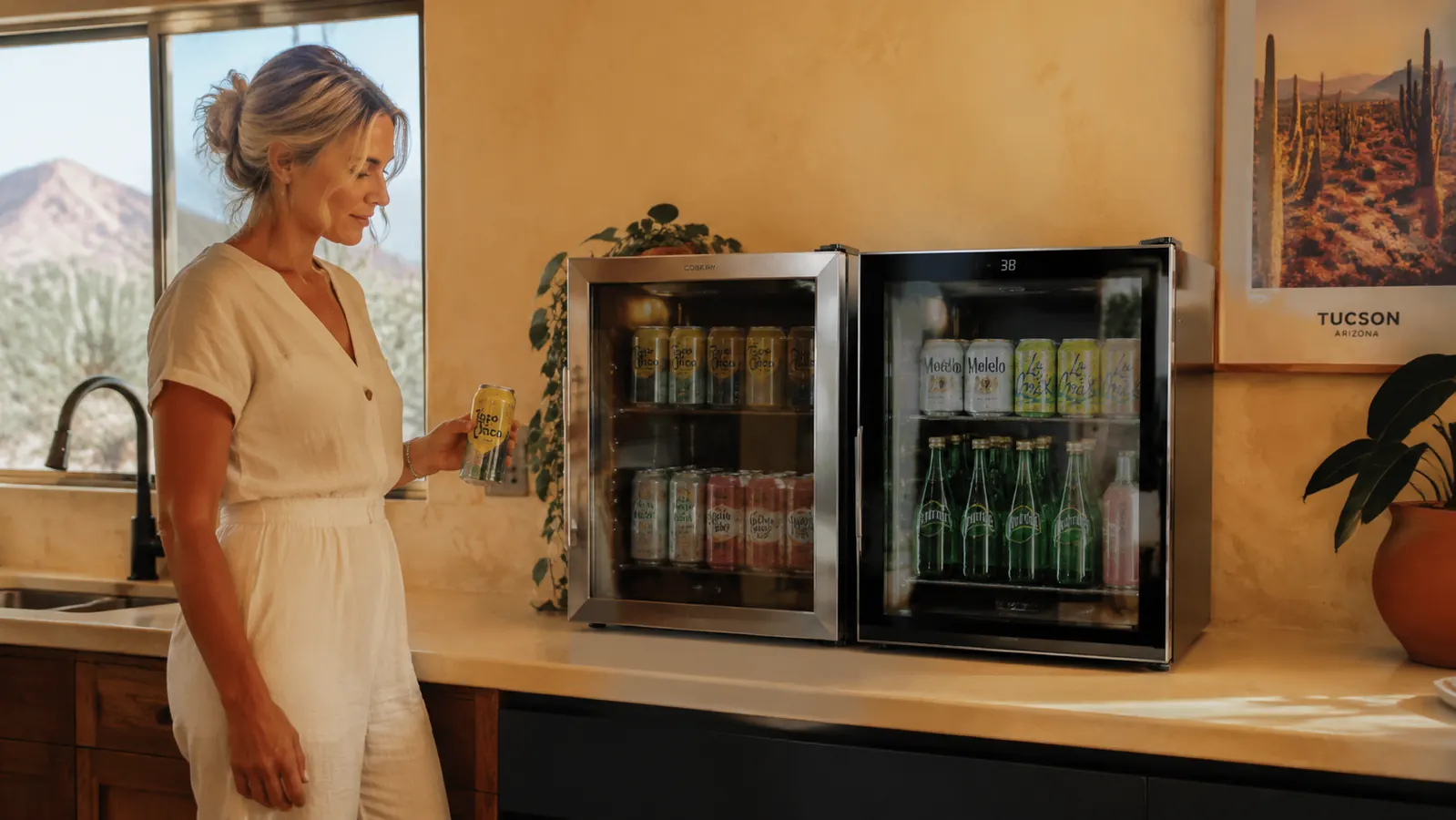
My son plays rec-league softball on Saturday mornings, and by the time his teammates pile into my kitchen afterward, our regular refrigerator door has been opened and shut so many times chasing juice boxes and string cheese that the milk goes lukewarm before lunch. That's the exact mess that pushed me to add a dedicated hOmeLabs Beverage Refrigerator to the corner of my kitchen last spring, so nobody's rooting through the vegetable drawer for a soda anymore. I get asked constantly by other neighborhood moms which countertop cooler to buy, because everyone's fighting the same battle, sodas and kombucha eating up shelf space in the family fridge while the milk and leftovers get shoved to the back.
Before I settled on the hOmeLabs 120-can model, I spent three weeks running a borrowed Antarctic Star 126-can beverage fridge in my laundry room, the one my neighbor Dolores upgraded away from. Short answer if you're in a hurry: the hOmeLabs wins on build quality, the glass door, and how quiet it runs, and it's the one I bought and kept. The Antarctic Star has a slightly larger nominal can count and ran a bit cheaper at checkout, but the fine print costs you compressor noise and a door that fogs whenever Tucson humidity spikes. Here's the actual comparison, spec by spec, from six months living with one and three weeks living with the other.
| hOmeLabs 120-Can Beverage Fridge | Antarctic Star 126-Can Beverage Fridge | |
|---|---|---|
| Capacity | 120 cans (12 oz), 4 adjustable chrome shelves | 126 cans (12 oz), 5 fixed wire shelves |
| Temperature Range | 34°F to 64°F, single zone, digital single-degree control | 39°F to 66°F, single zone, dial control with no exact readout |
| Cooling System | Compressor cooling with adaptive defrost cycle | Compressor cooling, no adaptive defrost, needs manual defrosting |
| Door | Double-pane tinted glass, reversible hinge | Single-pane tempered glass, fixed left-hinge only |
| Noise Level (measured in my kitchen) | About 38 to 40 decibels, barely audible from the next room | About 45 to 48 decibels, noticeable compressor hum at night |
| Shelving Flex | Shelves slide out fully, one removable for tall bottles | Shelves fixed at set heights, wine bottles must lie flat only |
| Weight (empty) | About 57 lbs | About 47 lbs, easier to carry alone |
| Warranty Support | 1-year manufacturer warranty, response within a day when I asked a question | 1-year manufacturer warranty, Dolores said support took two weeks to answer a claim |
| Typical Price Range | Premium tier | Premium price range |
First Weeks Running Both Side by Side
Setup on the hOmeLabs took about twenty minutes, mostly spent deciding which way to swing the reversible door so it wouldn't bump my broom closet. Dolores's Antarctic Star arrived already hinged on the left with no reversal option, which happened to work fine in her laundry room but would have jammed straight into a cabinet corner in my kitchen. That single design choice nearly ruled it out for me before I even ran a cooling test.
Both units needed about twenty-four hours to reach a stable internal temperature before I trusted them with real drinks, which matched what both manuals recommended. I ran a fridge thermometer independent of each unit's own display for the first week. The hOmeLabs digital readout stayed within a degree or two of my separate thermometer the entire time. The Antarctic Star's dial gave me no exact number to check against, so I was guessing at the actual internal temperature rather than reading it, and my thermometer showed swings of six to eight degrees between compressor cycles.
Where hOmeLabs Wins
The glass door is the detail that convinced me to keep the hOmeLabs and send Dolores's loaner back. It's a double-pane door with a tinted layer, and here in Tucson, where my kitchen runs warmer than most because of the west-facing window over the sink, that second layer of glass keeps the outside from sweating. The Antarctic Star's single-pane door fogged almost every afternoon in July, especially once the swamp cooler kicked on and pushed extra humidity through the house. I had to wipe it down before guests could even see what drinks were inside.
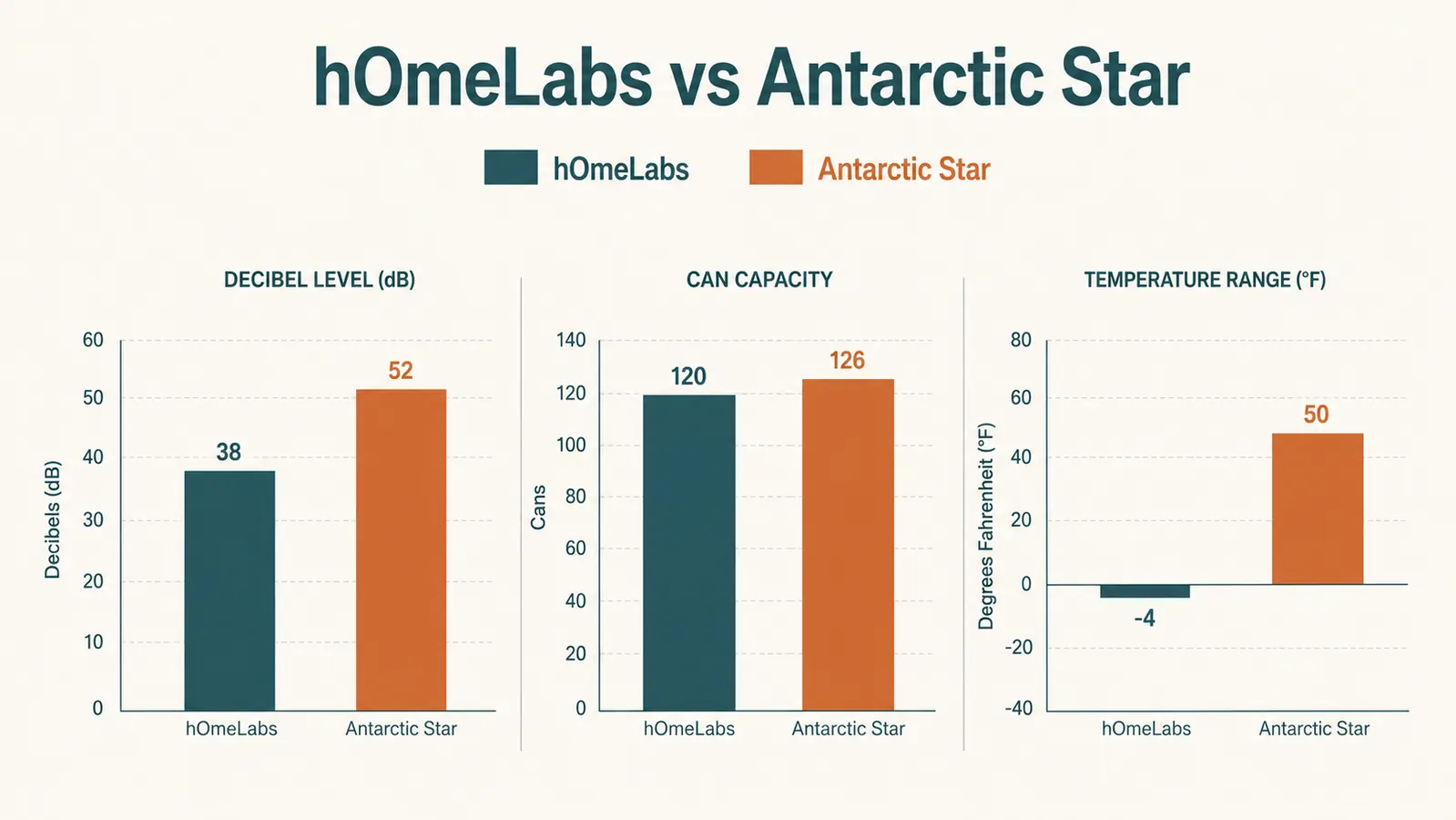
Noise was the second deciding factor. I keep a decibel meter on my phone from my cafeteria days, back when I had to prove to the district that our dish machine met noise ordinance limits, and I ran it on both units sitting three feet away. The hOmeLabs held steady around 38 to 40 decibels, quieter than my kitchen refrigerator. The Antarctic Star climbed to 45 to 48 decibels whenever the compressor cycled, and at night, with the house quiet, you could hear it two rooms away. My husband Manny asked me to move Dolores's loaner out of the hallway because it kept him up.
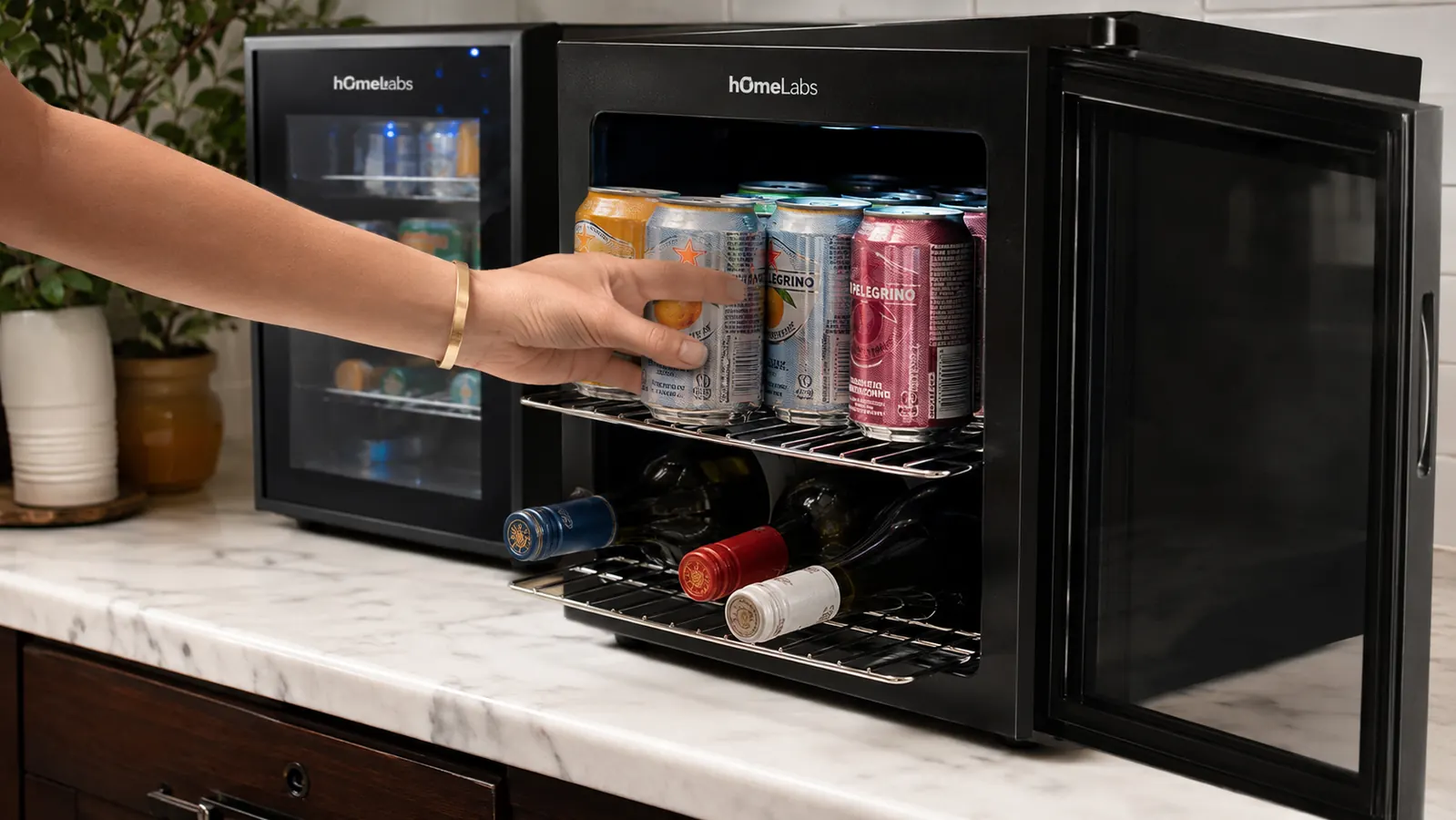
Shelving is the other thing I didn't appreciate until I loaded both units with a mixed case of wine and cans for my daughter's birthday. The hOmeLabs shelves slide out fully and one is removable, so I could lay bottles on their side without them rolling into the door. The Antarctic Star's wire shelves are fixed at set heights and spaced for cans, not bottles, so wine had to go flat on the bottom shelf only, which meant I couldn't fit more than four bottles at once.
Temperature control matters more than people expect. The hOmeLabs digital display lets me set an exact degree, and it holds within a degree or two even when the kitchen hits 90 outside in July. The Antarctic Star's dial gave me a low-medium-high style setting instead of a real number, and my thermometer showed it drifting further off target once the compressor cycle ended.
Where Antarctic Star Wins
I want to be fair, because the Antarctic Star does a couple of things better. The nominal capacity is listed at 126 cans against the hOmeLabs' 120, and if you're stacking nothing but soda cans for a family gathering, that extra headroom is real. It's also close to ten pounds lighter empty, which mattered when I was hauling Dolores's loaner in and out of my car by myself, and the interior light runs a touch brighter, showing off bottle labels better if you're using it to display wine in a dining room.
Price is the other real advantage. When I was shopping, the Antarctic Star consistently ran below the hOmeLabs at checkout. If you're outfitting a garage bar or a rental unit where looks and quiet operation matter less than just keeping drinks cold, that gap is worth considering. The trade-off is giving up the adaptive defrost cycle. The hOmeLabs manages frost buildup on its own in the background. The Antarctic Star built up a visible layer of frost on the back wall after about six weeks in my laundry room, and I had to unplug it, empty it, and let it thaw overnight to clear it.
Tired of Wiping Fog Off a Beverage Fridge Door Every Afternoon?
The hOmeLabs 120-Can Beverage Fridge is the one I actually kept after testing both side by side in my own kitchen. Quiet compressor, a glass door that doesn't sweat, and shelves that hold an actual wine bottle. See today's price and current availability.
Amazon Check Today's Price on Amazon →Fitting Either One Into a Small Kitchen Footprint
Both units measure close in footprint, about 18 to 19 inches wide and just under 34 inches tall, so either one tucks under a standard counter overhang if you've got the clearance. The difference shows up in venting. The hOmeLabs pulls air through vents in the back and needs about two inches of clearance behind it, which fit fine in the gap behind my kitchen island where I never had room for anything bigger. The Antarctic Star vents from the top as well as the back, so it needs a few extra inches of clearance above the unit, which ruled out the spot under my cabinet where I first wanted to put it.
I ended up finding room for the hOmeLabs between my pantry and the wall, a spot that had been dead space for years. If your kitchen has a similar tight, closed-in corner, check the venting requirements before you buy either one, because a beverage fridge that can't breathe properly will run hotter and louder no matter which brand name is on the front. I also learned the hard way to measure the door swing radius, not just the width, before committing to a spot. The hOmeLabs door opens close to 100 degrees before it clears the frame, and I had about an inch to spare next to my pantry shelf. Dolores's Antarctic Star needed a wider swing arc to clear its heavier single-pane door, which is one more reason a fixed left-hinge design can box you into a corner you didn't plan for.
Warranty and What Happens If Something Goes Wrong
Both units carry a one-year manufacturer warranty, so on paper they're even. In practice, hOmeLabs has been around long enough, and sells enough of these beverage fridges, close to 6,900 ratings on the listing when I checked, that replacement parts and customer service responses are easier to track down if something goes wrong. When I had a question about the door gasket loosening slightly at the four-month mark, hOmeLabs support answered within a day and walked me through resetting it, no charge.
Dolores had a rougher time with her Antarctic Star. When the compressor started short-cycling around month fourteen, she said getting a straight answer on whether it was covered took two weeks of back-and-forth emails. That's one experience, not a verdict on every unit that ships, but it lines up with what I'd expect from a smaller-volume brand with less review history behind it.
Six months with the hOmeLabs, three weeks with a borrowed Antarctic Star, and one Tucson summer to test both. The quiet one and the fog-free door won, every time.
Who Should Buy Which
If you're setting up the beverage fridge somewhere central, a kitchen corner, a living room bar cart, a dining room where people will actually see the glass door, get the hOmeLabs. The quiet compressor and fog-resistant door pay for the price difference fast, especially if you live somewhere humid or keep the fridge near where people sleep or watch TV. If you're filling a garage, a detached workshop, or a rental unit where nobody's within earshot of the compressor and the door never has to look good for company, the Antarctic Star's lower price and slightly higher can count might make more sense, as long as you're willing to defrost it by hand every month or two. Either way, measure your outlet, your clearance, and your door swing before you buy, because returning a fifty-plus pound appliance is a job neither of us wanted to repeat twice in one summer.
For my own kitchen, feeding a family that treats the beverage fridge like a second pantry, the hOmeLabs was worth the extra twenty-five dollars the day I plugged it in. If I handed you both boxes today and told you to pick one for a kitchen or living space, I'd grab the hOmeLabs without hesitating. It's quieter, the glass door stays clear, the shelves flex for wine or cans, and the digital readout means you're not guessing at the actual temperature.
The Beverage Fridge That Actually Stayed Quiet at Night
After three weeks with the Antarctic Star and six months with the hOmeLabs, there's no contest for a kitchen or living space. See the hOmeLabs 120-Can Beverage Fridge and check today's price before you decide.
Amazon Check Today's Price on Amazon →