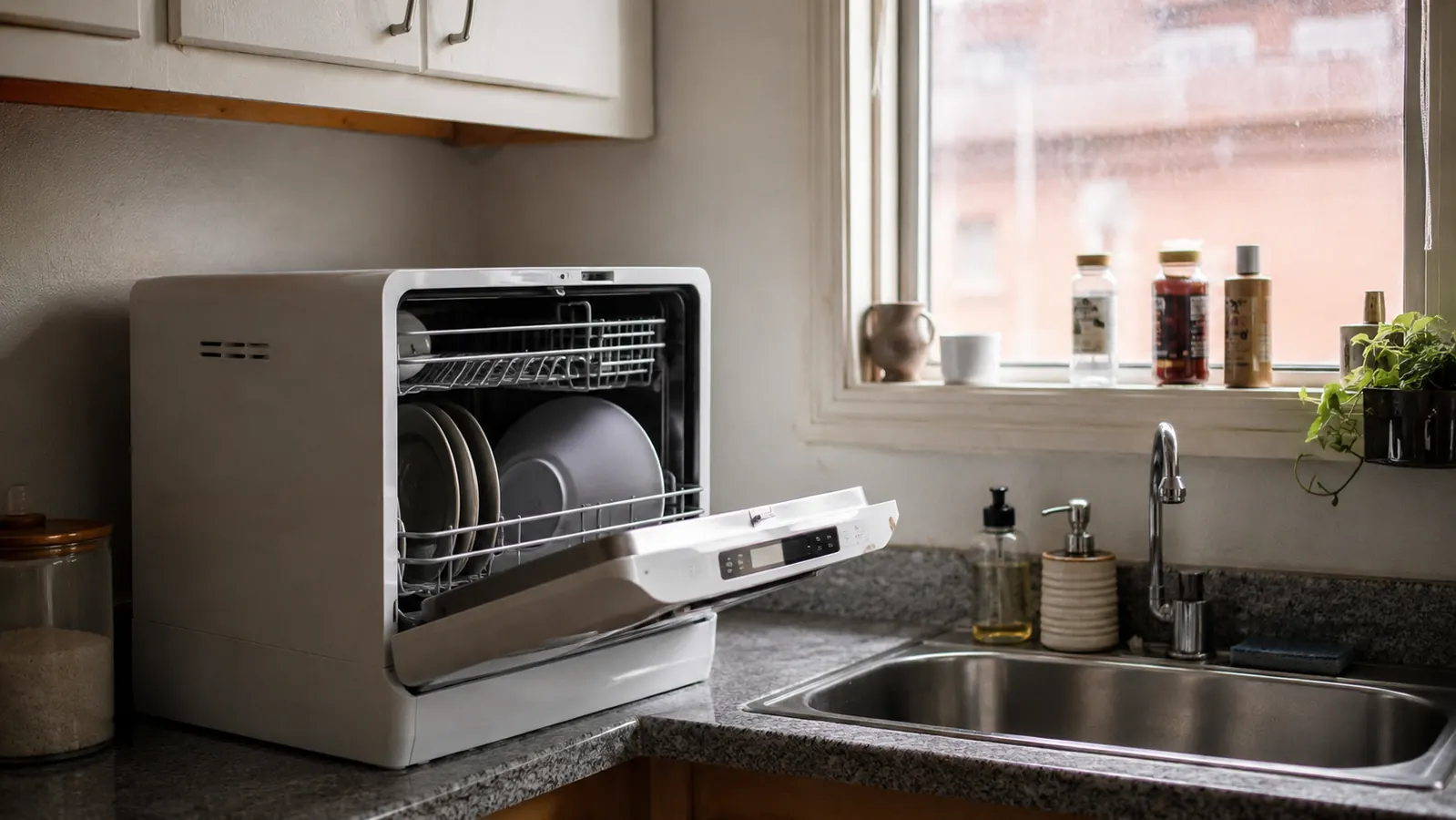
My daughter Elena moved into a 400-square-foot apartment in downtown Tucson last spring, and the kitchen had exactly 22 inches of counter between the sink and the stove. No dishwasher hookup, no room for one even if there had been, and a lease that flatly bans any modification to plumbing or cabinetry. She was hand-washing dinner for two every night after a ten-hour shift, and by week three she was calling me asking if this was just how apartment living worked now. I spent thirty years running dish machines that fed 600 kids a day at a school cafeteria, so I know exactly how much labor a working dishwasher saves a household, and I was not about to let a missing hookup be the reason she went without one.
The fix took one Saturday afternoon and cost nothing beyond the appliance itself. We used a COMFEE' Portable Mini Dishwasher, a countertop unit that runs off the kitchen faucet instead of a plumbed line, and it has been running six nights a week in that same tiny kitchen for almost a year now. This guide walks through the exact steps we used to measure, place, hook up, and run it, so you can do the same in your own no-hookup kitchen without touching a pipe or calling a landlord for permission.
Skip the plumber. This one just plugs into your faucet.
The COMFEE' Portable Mini Dishwasher hooks up to a standard kitchen faucet in under five minutes and runs on regular countertop outlet power. No installation, no landlord sign-off, no cut walls.
Amazon Check Today's Price on Amazon →Step 1: Measure your counter and your faucet before you buy anything
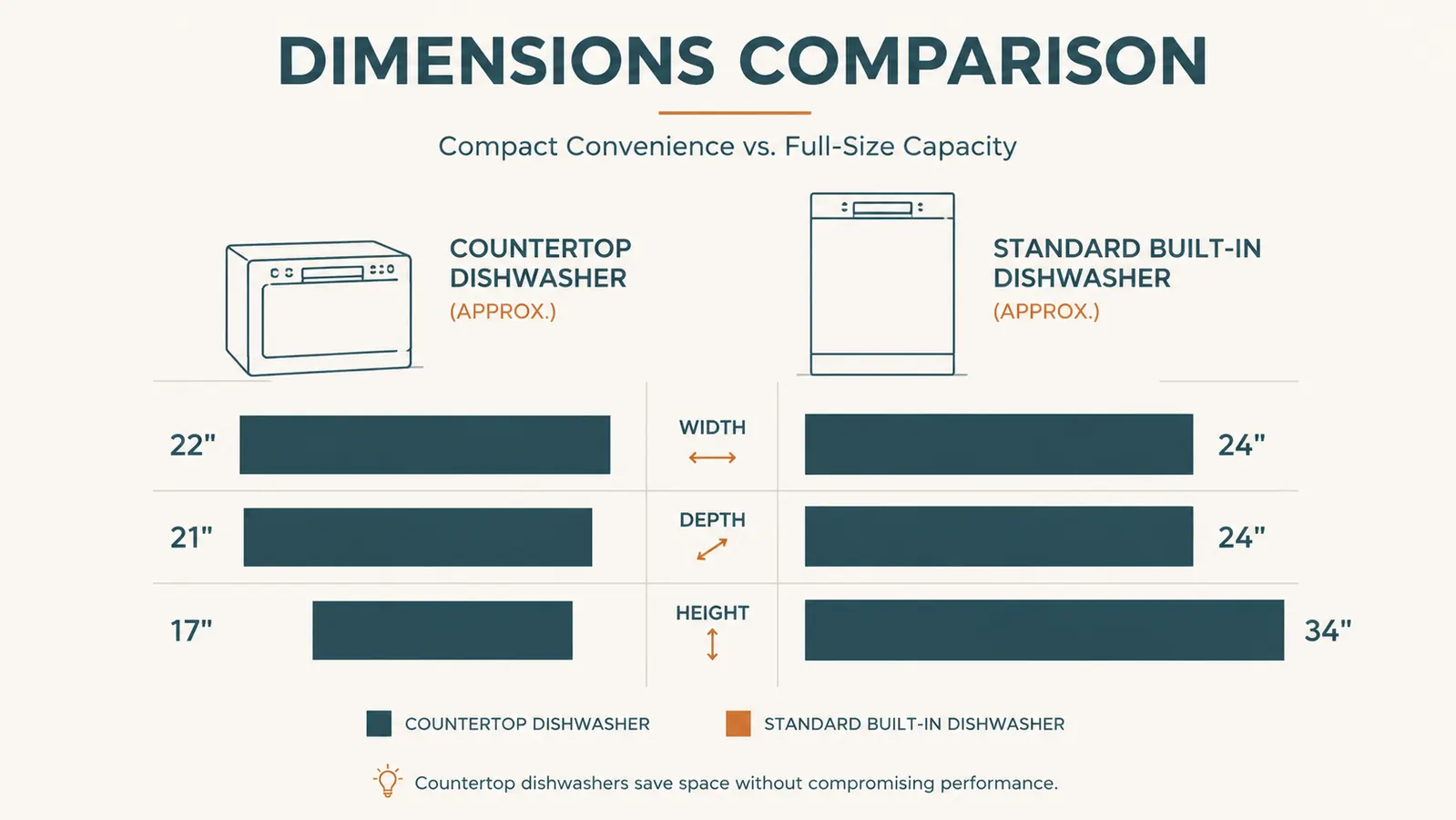
Before Elena ordered anything, I made her measure three things with an actual tape measure, not a guess: the clear counter depth from the front edge to the backsplash, the counter width available next to the sink, and the height from the counter to the underside of any cabinet above it. The COMFEE' unit runs about 22.4 inches wide, 21.3 inches deep, and 17 inches tall, and it needs a few extra inches of clearance on the side where the hoses connect so you can loop them without kinking.
The part people skip is the faucet itself. Pull the aerator off the end of your kitchen faucet (it unscrews counterclockwise, usually by hand) and check the threading. Most residential faucets in the US take a standard 15/16-inch female or 55/64-inch male thread, and the COMFEE' comes with a universal adapter kit that covers both, but if your faucet has a pull-down sprayer head or a European-style thread, measure it and check the adapter kit's compatibility list before you order.
We also checked the outlet situation. The dishwasher needs its own standard grounded outlet, it draws about the same power as a microwave mid-cycle, so an outlet already loaded up with a coffee maker and a toaster on the same circuit can trip a breaker. Elena's kitchen had a single outlet behind the counter, which was enough on its own once we unplugged the toaster during wash cycles. If your apartment only has one outlet total, a labeled power strip rated for kitchen appliance loads works, but never share it with anything else that heats, like a toaster oven or electric kettle.
Step 2: Pick the exact spot and plan the hose path
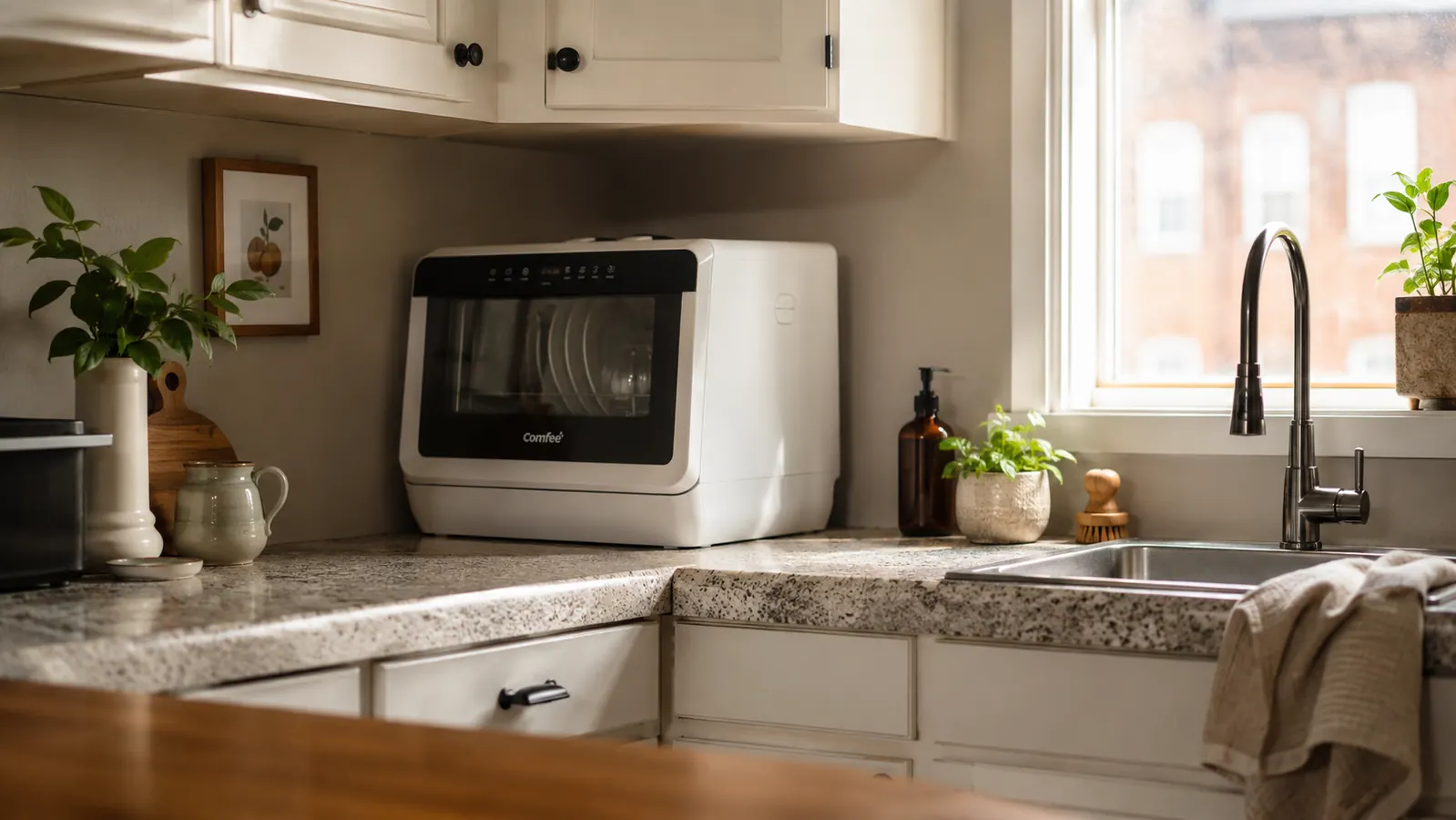
In a 22-inch counter run, there usually is not a spot that just works, you have to make one. We ended up placing the COMFEE' dishwasher directly beside the sink, on the side closest to the outlet, so the inlet and drain hoses could both reach without stretching across the sink basin or draping over the edge of the counter where someone could catch a foot on them.
Before locking in the placement, we did a dry run with both hoses laid out but not connected, just to see how they would sit once the unit was pushed into its final spot. The inlet hose runs from the back of the dishwasher up to the faucet adapter, and the drain hose runs from the back down into the sink basin or, if you prefer, into a drain line under the sink with the included adapter. We chose the sink-basin drain option because Elena rents and did not want to modify anything under the cabinet.
One thing I learned the hard way at the cafeteria and passed on to her: leave a small gap, an inch or two, between the dishwasher's back panel and the wall or backsplash. The unit vents heat and steam out the back during the dry cycle, and crowding it against the wall traps moisture that can eventually warp cabinet laminate or peel a rental's peel-and-stick backsplash tile.
Step 3: Connect the faucet adapter and test for leaks before loading a single dish
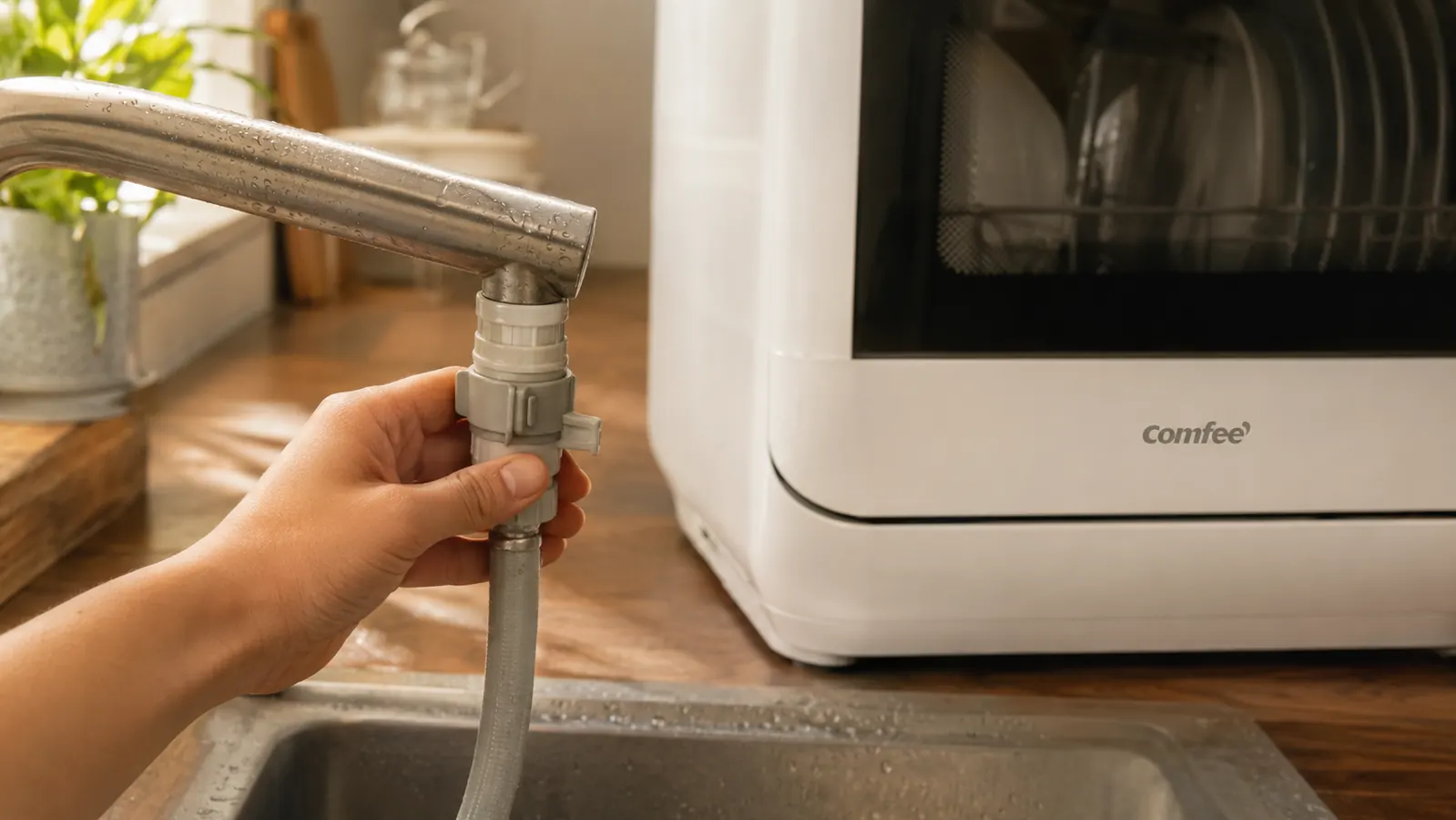
This is the step people rush, and it is the one that causes almost every complaint I have seen about countertop dishwashers leaking. Screw the correct adapter onto your faucet spout by hand until it is snug, then hand-tighten the inlet hose connector onto the adapter. Do not use a wrench, these fittings are designed for hand tightening and over-torquing them cracks the plastic threads.
Turn the faucet on to a moderate flow, not full blast, and watch the adapter connection for about thirty seconds before you do anything else. If water beads or drips at the joint, back the connector off, check that the rubber gasket inside is seated flat, and reconnect. We had a slow drip on our first try because the gasket had shifted during shipping, a five-second fix once we caught it.
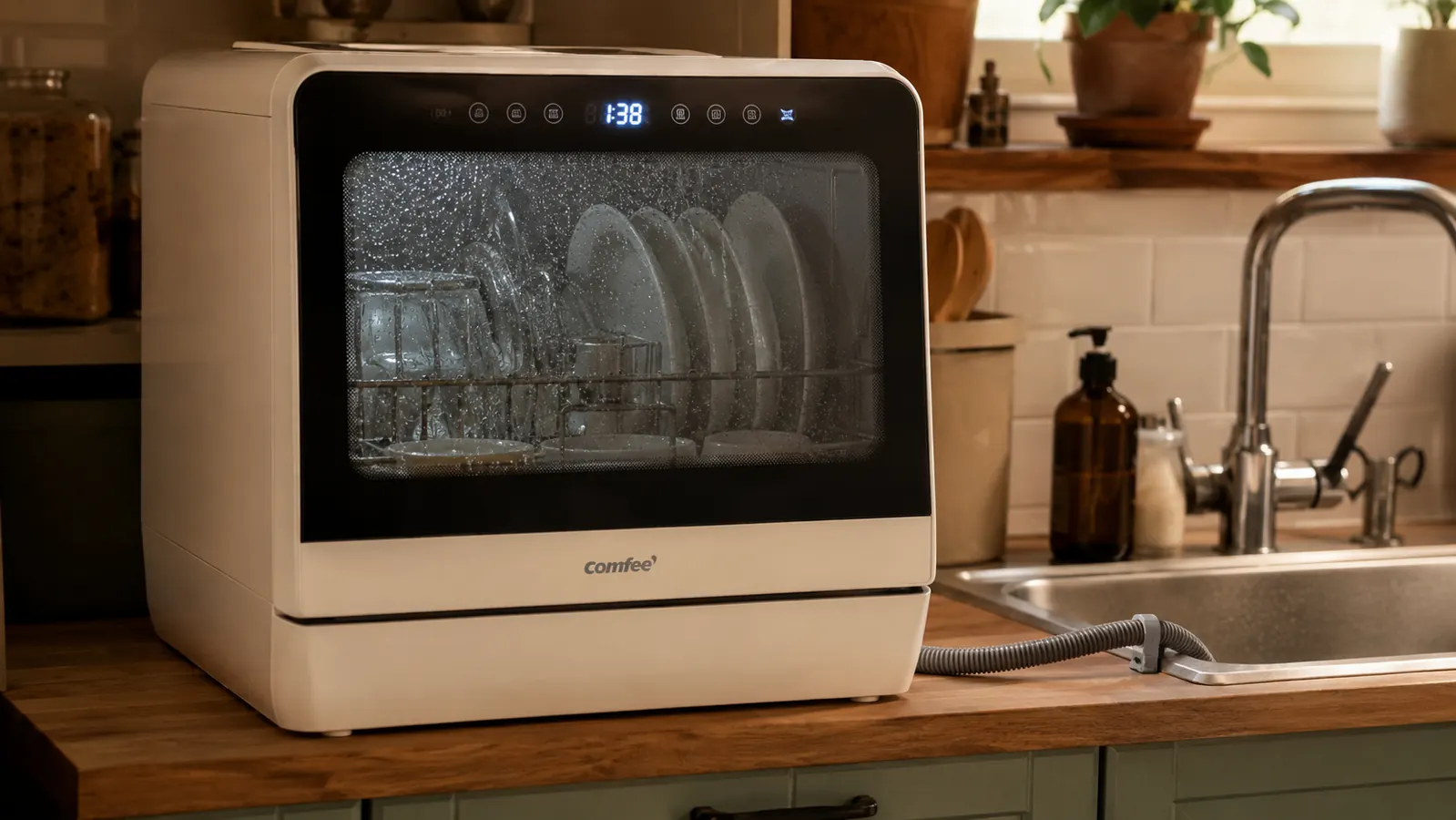
Once the connection holds dry, run the dishwasher's built-in rinse or quick cycle empty, no dishes, no detergent. This flushes any manufacturing residue out of the internal lines and lets you watch the drain hose do its job into the sink basin. Elena's first empty cycle ran about 25 minutes on the fastest setting, which told us the water pressure in her unit was strong enough for a full cycle later.
Step 4: Load smart for a small machine and pick the right program
A 6 place-setting countertop dishwasher is not a shrunk-down version of a full-size dish machine, it is a different loading puzzle. Plates go in the back rows standing on edge, angled slightly so water sprays across the face instead of pooling on top. Bowls and cups go upside down in the front rack so they do not collect standing water. Anything with baked-on sauce or dried egg gets a quick pre-rinse under the faucet first, because a compact wash arm does not have the water volume to blast through heavy soil the way a full-size unit does.
The COMFEE' unit gives you 8 washing programs, and we settled into a routine fast. Weeknight dinner dishes get the standard 90-minute wash. Baby bottles and sippy cups (Elena watches her niece two days a week) get the dedicated Baby-Care cycle, which runs a hotter final rinse. Wine glasses and anything delicate get the Glass cycle, which uses a gentler spray pressure so nothing chips against the rack. The Speed cycle is for a handful of dishes when you are in a hurry and can live with a slightly less thorough wash, and the ECO cycle is what we default to on nights when the dishes are light and Elena wants to keep the water bill down.
We also learned to run the machine full but not crammed. Six place settings sounds small, but it comfortably covers two people's full day of cooking and eating if you load it right, plates, bowls, glasses, and the pans from dinner prep. Running it half-empty every night just to keep up wastes water and defeats the point of having a dishwasher at all, so on lighter nights we just let dishes sit in the sink one extra day rather than starting a half-full cycle.
Step 5: Build the daily habit around a shared faucet
The one real tradeoff of a no-hookup dishwasher is that it borrows your faucet, so you cannot run water at the sink while a cycle is going. We solved this by treating the dishwasher like a load of laundry: start it before bed or before heading out the door, not in the middle of cooking dinner when you need the sink free.
Disconnecting and reconnecting the adapter takes about fifteen seconds once you have done it a few times, so if you do need the faucet mid-cycle for something quick, you can pause the machine, unhook the inlet hose, and reconnect it a few minutes later without losing the cycle. We kept a small towel clipped near the sink specifically for catching the few drops that come out of the hose ends during disconnect, which saved the counter from constant wiping.
Within about two weeks it stopped feeling like extra work and just became part of the evening routine, same as starting a load of laundry before bed. That is the real test of whether a no-hookup dishwasher fits a tiny kitchen: not whether it technically works on day one, but whether it disappears into the routine by week three.
What Else Helps
A couple of small additions made the whole setup smoother. A rubber-backed drying mat folded next to the dishwasher gives you a landing spot for the few hand-wash items, like sharp knives, that should never go in any dishwasher, countertop or otherwise. If more than one person shares the kitchen, a faucet splitter adapter lets someone run the sink for a quick task while the dishwasher's own line stays connected on the other port, though we found we rarely needed it once we settled into an evening-run habit. And if your apartment has an older electrical panel, plug the dishwasher directly into a wall outlet rather than a power strip shared with other kitchen appliances, both to avoid tripped breakers and because most manufacturers note that shared power strips can void the warranty on the heating element.
Worth mentioning for apartment living specifically: run cycles at reasonable hours if you share walls. The COMFEE' unit is not silent, it hums and clicks through its wash phases the way any dishwasher does, and a 9 pm start on a weeknight is a lot friendlier to neighbors in an older building than a midnight cycle right before you head to bed. Elena runs hers right after dinner instead of waiting until she is ready to sleep, and it has never come up as an issue with the couple next door.
It is not a shrunk-down dishwasher, it is a different tool that solves the same problem for a kitchen that was never built to have one.
Give your tiny kitchen the one appliance it was missing.
The COMFEE' Portable Mini Dishwasher fits kitchens with zero plumbing hookup, runs off your existing faucet and outlet, and handles a full day's dishes for two people on one cycle.
Amazon Check Today's Price on Amazon →