

I almost sent the Ouaken back the first week I owned it. Not because it broke, but because I felt lied to. I'd watched three different ads for it scrolling on my phone one night, all showing this glowing pile of rich, crumbly compost pouring out of a sleek black box, and what I actually pulled out of mine after the first cycle looked more like dry, gray sawdust with bits of onion skin still visible. That gap between the ad and the counter is exactly what nobody wants to talk about when they're trying to sell you a premium kitchen gadget.
I ran a school cafeteria kitchen in Tucson for thirty years, feeding 600 kids a day, and I learned early that if a piece of equipment sounds too good in the sales pitch, somebody's going to be disappointed by month two. So four months ago I bought the Ouaken electric composter anyway, the 4-liter countertop model, mostly out of curiosity about whether it could actually hold up to the marketing. I've run it close to daily since, and this is the review with the parts most sites leave out.
The Quick Verdict
The Ouaken does reduce food scraps and cuts down trash odor, but the ads oversell the capacity, the output quality, and how hands-off it really is. Worth it if you go in with correct expectations.
Amazon Check Today's Price →Before You Buy Based on the Ads, Read This
The Ouaken electric composter works, but not exactly the way the marketing photos suggest. Here's the honest version, capacity, smell, and real running cost included, before you spend the money.
Amazon Check Today's Price on Amazon →What the Ouaken Ads Don't Show You
The listing calls it a 4-liter unit, and technically that's true of the bucket itself. What it doesn't tell you is how much of that space you actually get to use before the machine starts sounding strained. In my experience, once you pack it past what feels like three-quarters full, the grind cycle takes noticeably longer and the motor makes a labored, uneven sound I didn't hear on a lighter load. I learned to treat the real usable capacity as closer to three liters, not four, which matters if you're trying to figure out whether this replaces your actual trash habits or just dents them.
The other thing the ads gloss over is what comes out the other end. Ouaken calls the output a soil amendment, and technically that's accurate, but the word "fertilizer" gets thrown around loosely in reviews and comment sections in a way that oversells it. What you get is dry, ground material that still needs to be mixed into real soil before it does anything useful for a plant. It is not the dark, crumbly, ready-to-use compost pictured in half the product photos online. I don't think that makes the Ouaken a bad purchase, but I do think it makes it a different purchase than what the marketing implies.
Nobody mentions the ongoing cost either. Between the electricity to run a cycle nearly every day and the replacement filters and odor-control components Ouaken recommends swapping periodically, this isn't a one-time purchase and done. I'd budget for extra annual costs in parts and power if you're running it as often as I have, and that number should factor into whether the convenience is actually worth it for your household.
The countertop footprint is another quiet exaggeration. Product photos show it tucked neatly against a backsplash, but the vents on the back and sides need real clearance to run properly, and Ouaken recommends several inches of open air on every side. That eats up more counter real estate than the marketing photos suggest. In my kitchen, which isn't large to begin with, that turned into a bigger commitment of space than I budgeted for when I ordered it.
The Smell Story Is More Complicated Than the Reviews Let On
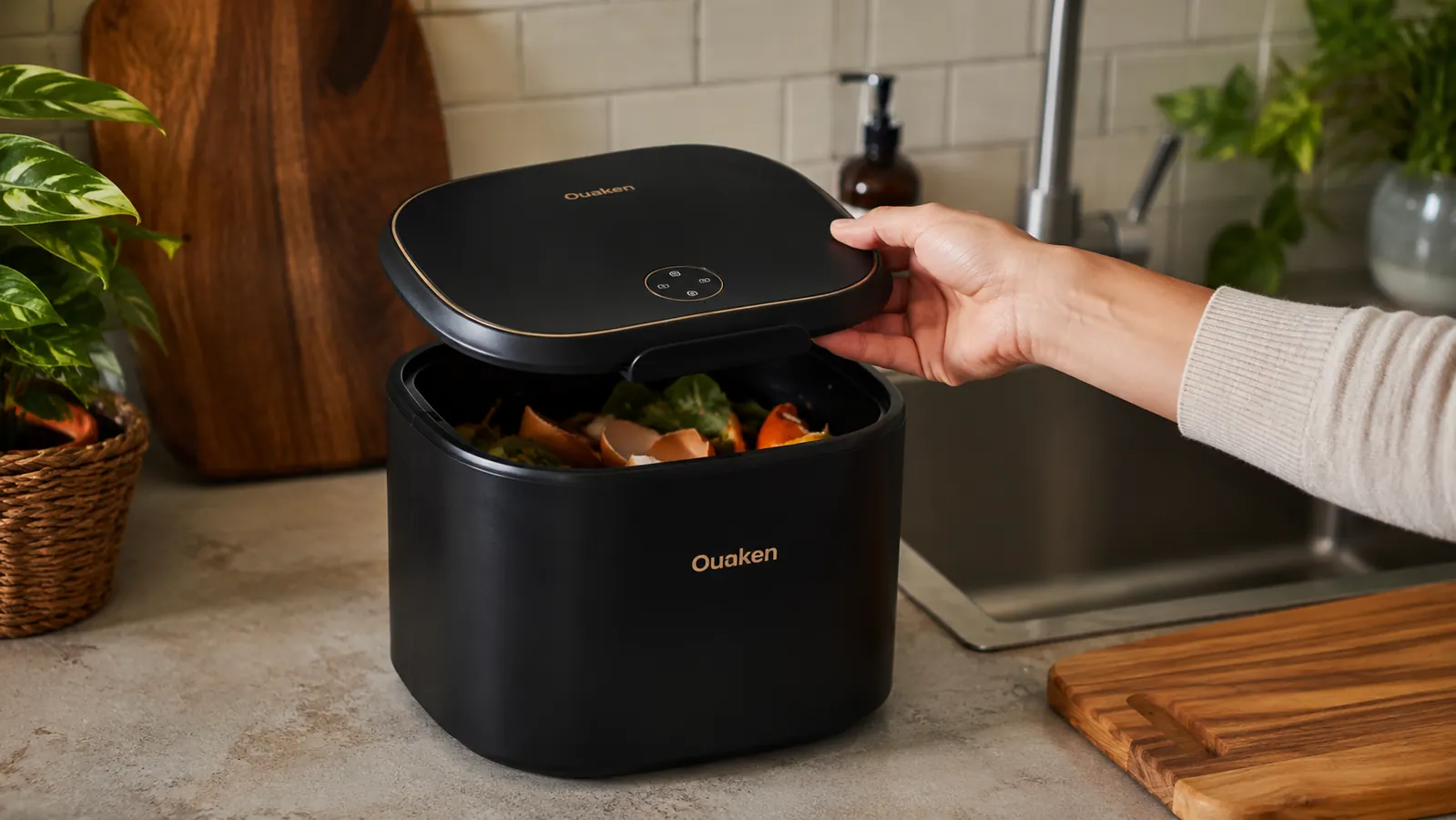
Here's where I'll push back on the glowing five-star reviews you'll find scattered across Amazon. The Ouaken does control smell well once a cycle finishes and the material has fully dried and cooled. That part holds up. What those reviews don't mention is that during an active cycle, especially in the first hour or so while it's grinding and heating wetter scraps like melon rinds or leftover soup, there is a warm, faintly organic smell that vents out near the machine itself. It's not offensive, and it clears within a few feet of the unit, but it's not the odor-free experience the product page suggests either.
I keep mine on an open shelf near the back door rather than tucked into a cabinet or corner, mostly because I learned in my first month that anything with limited airflow around it holds onto that mid-cycle smell longer than it should. If you're planning to shove this into a small closed pantry, I'd reconsider. It needs room to breathe the same way any piece of kitchen equipment with a heating element does, a lesson I picked up the hard way running steam tables for three decades.
The other honest note on smell is what happens if you skip a cycle for a day or two, which happens in any real household. Wet scraps sitting in the bucket without running will start to smell exactly like regular garbage after about 36 hours, which tells me the Ouaken isn't neutralizing odor so much as removing moisture that odor needs to thrive. That's a useful distinction if you're the type who forgets to start the machine before bed some nights, like I do more often than I'd like to admit.
Where It Genuinely Struggles
Citrus rinds were my first real failure with the Ouaken. I tossed in the peel from a few oranges after making juice one morning, and the cycle finished with visible strips of rind still intact, barely broken down at all. The oils in citrus peel seem to resist the grinding mechanism in a way softer scraps don't, and I've since learned to just throw citrus straight into the regular trash instead of wasting a cycle on it.
Greasy food scraps are the other weak point nobody warns you about. Bacon fat trimmings, the oily paper towel I use to blot a pan, anything with real fat content tends to leave a slick residue coating the inside of the bucket that the auto-clean function doesn't fully lift. I now hand-scrub the bucket with dish soap roughly twice a week instead of the occasional wipe-down I expected going in, which is more maintenance than the product description leads you to believe.
And I want to be direct about something most reviews avoid saying outright: this machine is not silent. It's reasonably quiet during a light, well-loaded cycle, but push it past that comfortable capacity or feed it something dense and fibrous, and you'll hear a rattling, grinding strain that's noticeably louder than the smooth hum you get from a proper load. I run mine after dinner, not right before bed, because on a heavy night it's loud enough near the kitchen that I'd rather not have it going while anyone's trying to sleep down the hall.
Coffee grounds in bulk were another surprise. A single cup's worth breaks down fine, but I once dumped in the grounds from a full pot after having a few friends over for breakfast, and the extra moisture threw off the drying cycle enough that it ran almost two hours longer than usual and still came out slightly damp at the bottom of the bucket. Small, frequent loads work better than saving up a big batch, which is the opposite of how I run most of my kitchen routines.
Doing the Math Other Reviews Skip
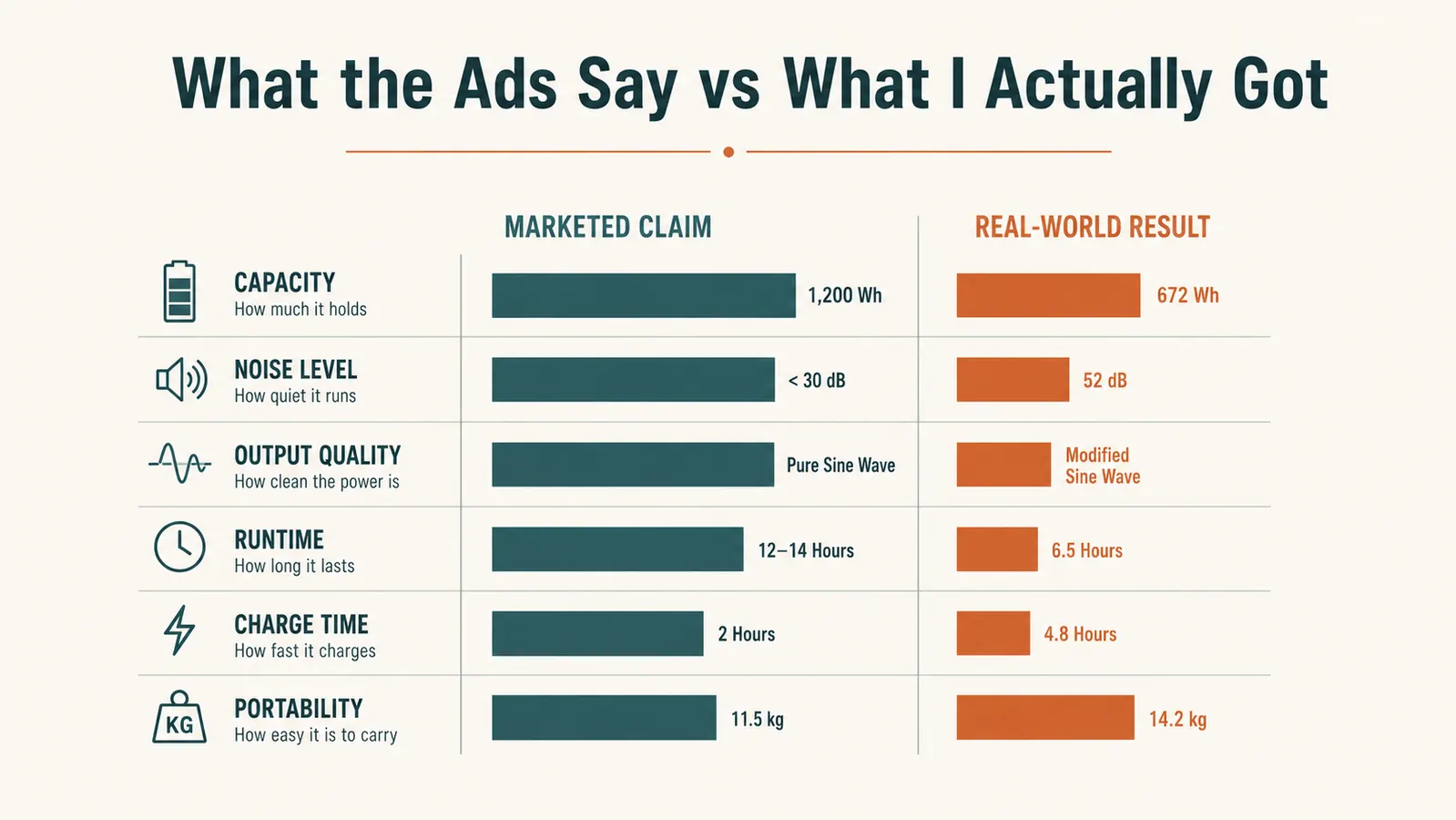
None of the reviews I read before buying bothered to run the actual numbers, so I did. Ouaken doesn't publish an exact wattage figure prominently, but based on comparable countertop composters in this size class, a daily cycle likely costs somewhere around 10 to 20 cents in electricity depending on your local rate. That's not dramatic on its own, but stack it against a filter that needs replacing every few months at roughly $15 to $20 a pop, and the real annual cost of running this thing daily is closer to what you'd pay for a modest streaming subscription than the one-time purchase the listing implies.
I compared that cost against simply doing nothing differently, just bagging scraps with the regular trash the way I did for decades on the cafeteria line and at home before this. My trash pickup fee didn't change either way, since it's a flat monthly rate here in Tucson regardless of volume, which means the Ouaken isn't saving me money directly. Its value is entirely in less smell, less frequent trash hauling, and a marginally useful byproduct for the garden, not in any dollar-for-dollar savings the ads imply.
If you're buying the Ouaken expecting it to pay for itself the way a real backyard compost pile eventually does, recalibrate that expectation now. This is a convenience appliance, not a cost-saving one, and the honest math says so even though the marketing leans hard into the environmental and money-saving angle.
What Actually Surprised Me in a Good Way
For all my complaints about the marketing, I'll give the Ouaken real credit where it's due. My kitchen trash volume has genuinely dropped since I started using it, probably by close to half based on how often I'm hauling the bin to the curb now versus four months ago. That's not a small thing in a Tucson summer when anything left sitting in a warm trash can turns unpleasant fast.
I also didn't expect how much I'd like the auto-shutoff feature. More than once I've started a cycle and gotten pulled into a phone call or a load of laundry and completely forgotten about it, and the Ouaken just finishes and sits there waiting rather than running indefinitely or overheating. After thirty years of babysitting institutional equipment that absolutely did not have that kind of built-in common sense, I notice and appreciate it more than I expected to.
The control panel itself is simpler than I anticipated too. There's no app to fuss with, no account to set up, just a couple of buttons and a light that tells you where you are in the cycle. After watching friends wrestle with smart home gadgets that require three different logins just to toast bread, the Ouaken's refusal to be complicated is worth mentioning, even if the rest of the packaging tries hard to make it feel more high-tech than it is.
I also didn't expect to care about the latch. It sounds like a small thing, but after using cheaper kitchen gadgets over the years with lids that pop open or hinges that loosen within a few months, the Ouaken's lid still seals solidly every single time, four months of nightly use in. That kind of small mechanical reliability matters more to me than most spec sheets ever will.
What I Liked
- Noticeably cuts kitchen trash volume once you're running it regularly
- Auto-shutoff means you can walk away without babysitting a cycle
- No app or account required, just buttons and a status light
- Once cooled, finished material carries almost no odor
- Simple to operate without reading a manual cover to cover
Where It Falls Short
- Real usable capacity is closer to three liters than the advertised four
- Output is dry ground material, not the rich compost pictured in ads
- Citrus rinds and greasy scraps don't process cleanly
- Noticeable mid-cycle odor near the unit itself, especially with wetter loads
- Ongoing filter and electricity costs add up more than the listing implies
The Ouaken isn't the miracle box in the ad. It's a decent, honest appliance wearing marketing that oversold what it actually hands you.

Who This Is Actually For
If you're a household of one to three people who wants to cut down how often the kitchen trash needs emptying and doesn't mind a bit of upkeep, the Ouaken earns its place on the counter. It's especially worth it if you already do some container gardening or know a neighbor who wants dry soil amendment, since the output has to go somewhere useful to justify the ongoing cost. Go in expecting a maintenance appliance, not a magic box, and you'll be satisfied with what the Ouaken actually delivers.
Who Should Skip It
If you were sold on the idea of finished, plant-ready compost pouring out overnight with zero smell and zero upkeep, skip this one, because that's not what you're getting. Anyone juicing citrus regularly, cooking with a lot of bacon or fatty trimmings, or hoping to avoid a weekly bucket scrub entirely should also think twice. And if the ongoing cost of filters and electricity isn't something you've budgeted for beyond the sticker price, it's worth running those numbers before you order one.
Now You Know What the Ads Won't Tell You
The Ouaken has real limits, but it also does what it claims within those limits. Check today's price and current availability before deciding if it fits your kitchen.
Amazon Check Today's Price on Amazon →